What Comes Before Design
Where Does Design Begin? What is the question you ask before designing?
The Question That Led Me Here
The day after returning from 3 Days of Design in Copenhagen, a designer friend asked me: "How did you like it?"
Since most of the showcased projects were furniture-related, which is not my area of expertise, my first response was: "It was cool. Just not really my field of interest." Meanwhile, a situation from the event came back to my mind. I remember trying to start a conversation with a designer by asking what led him to his design. His answer was simple:
“"I wanted it to feel artistic."
And that was where I got stuck. I didn't know how to continue the conversation.
Later, when I shared this experience with my designer friend, another voice appeared:
"You are a designer as well. You should be able to find the connection." To be honest, that thought made me slightly uncomfortable. Not because I disagreed with it, but because it made me wonder why I felt disconnected in the first place.
Throughout my education, I was taught to start with questions such as:
What problem is this solving?
Why should it exist?
Who is it for?
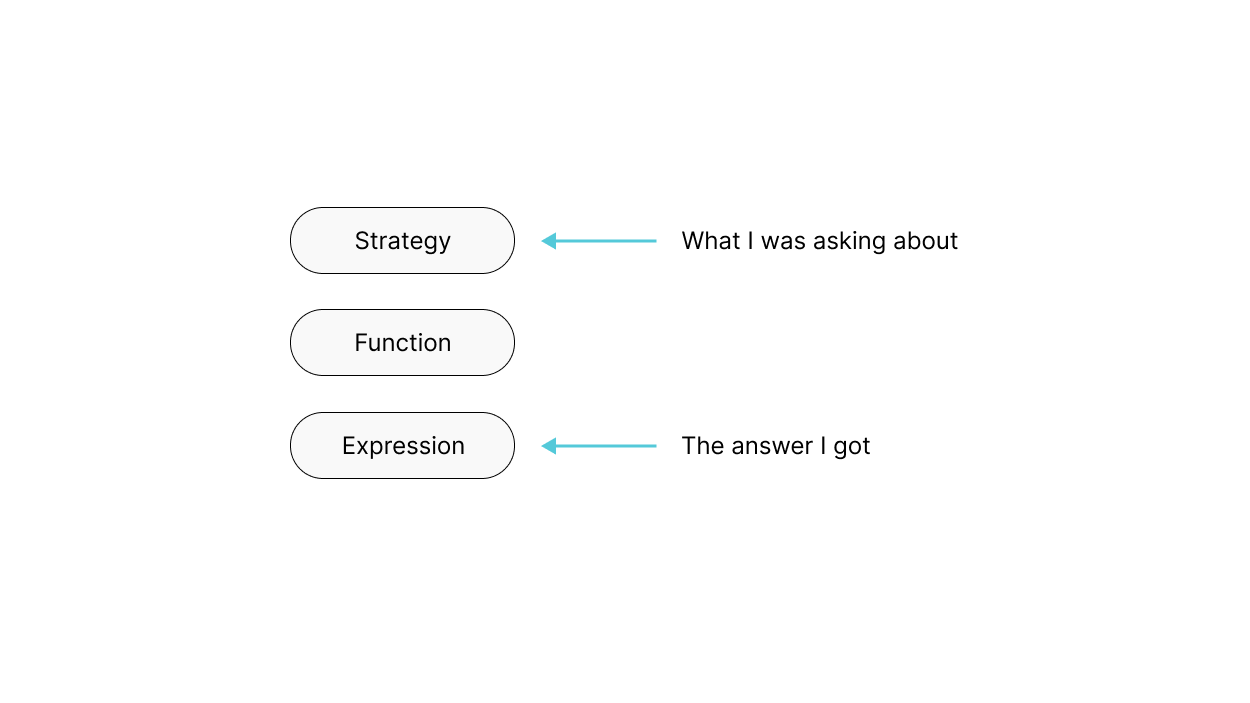
These questions naturally lead me to think from a needs-driven and reasoning-oriented perspective. The conversations I encountered at the event seemed to start somewhere else.
These questions naturally lead me towards understanding purpose, function, and reasoning. The conversation I encountered at the event, however, started from expression.
It was simply a mismatch of perspectives. We were approaching the same topic from different entry points, and therefore searching for different answers.
That made me wonder whether the same thing happens in design projects. Perhaps the differences in our outcomes begin much earlier than the design process itself.
Why Are We Looking for Different Things
Different perspectives don’t appear by accident.
More often, they are shaped by what a project is trying to achieve.
Before any sketches are made, every project already carries an objective. Sometimes it is self-expression. Sometimes it is business growth. Sometimes it is solving a user problem. Those objectives naturally influence what receives attention throughout the design process.
A designer creating a personal project may be motivated by self-expression. Naturally, questions about form, material, and visual language become important.
A startup founder may be motivated by finding product-market fit. The focus shifts towards customer needs, differentiation, and business opportunities.
An in-house company may be motivated by long-term growth. Questions about positioning, portfolio, and strategy become increasingly relevant.
Agencies often work within a client's objectives while trying to offer unique value. As a result, differentiation, storytelling, and presenting multiple directions frequently become part of the process.
As designers, we often sit somewhere in the middle of these perspectives.
We are not only designing objects, we are interpreting motivations.
Before deciding how something should look or function, we first need to understand what the project is trying to achieve. Once the objective becomes clear, the questions we ask become clearer as well.
A designer often sits between multiple stakeholders whose objectives are not aligned.
I experienced this while designing a pop-up store.
It was a project without a brief. The store needed to be built within three weeks, leaving less than a week for concept development.
At first glance, the task seemed straightforward: develop concepts for a temporary retail space. However, I then realized that I was designing between two different objectives.
From the agency's perspective, our responsibility was to create value for the client. Internally, this translated into presenting three concepts with clearly different visual directions. If all three looked similar, there would be little reason to develop multiple proposals in the first place.
Understanding Before Designing
Agency’s focus: creating value.
My focus as a designer: creating distinct concepts and exploring different customer experience.
The client's objective, however, appeared to be very different. The store needed to be designed, produced, and built within three weeks. Speed and feasibility became far more important than exploring multiple directions.
Client’s focus: speed.
It ended up taking me four days to develop three completely different concepts.
When we finally presented the work, the client had already decided to move forward with their own concept due to the tight schedule. Interestingly, their solution largely reused their existing layout, which, from the agency's perspective, would probably not have been considered particularly creative.
After the project, I started reflecting on why I had spent so much effort on concepts that were never even evaluated.
I then realized that the project had been misaligned from the very beginning. Different stakeholders were working towards different definitions of success.
For the agency, success meant demonstrating creative value by presenting multiple distinctive concepts.
For the client, success meant opening the store as quickly as possible.
As the designer, I was trying to satisfy both.
What Experience Actually Teaches
Perhaps one of the most valuable abilities a designer can develop is identifying what matters most before moving towards solutions, and understanding how to align design with the project's objective.
I sometimes discuss this with my partner: what do we actually gain after working in the industry for several years?
When I look at student projects from UID today, I am genuinely impressed. Their technical skills are exceptional. They have access to better software, more powerful tools, and now AI has lowered many technical barriers.
So where does experience make a difference?
I don't think the answer is simply "better skills." Instead, I think experience gradually changes the way we evaluate a project.
The pop-up store project made me realize that the quality of a design and the success of a project are not always measured in the same way. In that project, timing ultimately mattered more than the concepts themselves.
Perhaps this is also why designers sometimes struggle to understand each other:
We may be discussing the same project, but evaluating it through completely different objective.