What Remains When Everything Can Be Generated
Observations on AI in design, and what may still belong to designers.
A Transition Moment in the Industry
AI is being applied across multiple layers of the design process—from generating visuals to organizing and processing information. In many ways, it is becoming a standard part of how work is done. When used intentionally, it can significantly accelerate the process. But at the same time, it also raises a different kind of question.
Recently, an ID intern in our studio asked an interesting question:
“Do you think AI will replace us completely?”
What I found interesting was not just the question itself, but the word “completely.” This question obviously suggests a concern that goes beyond change, and toward replacement.
Will AI take our jobs? My answer is yes, partly and only to a certain degree.
However, I also observed that sometimes people have misunderstanding of creativity. II remember visiting a renowned local artist in my hometown back in 2023. There was an uninvited guest present at the time. He looked at the artist’s work and said, “AI can generate something like this in a minute. Your work will soon be worthless.” That was quite interesting. This artist had a very distinctive personal style. Without the foundation of his work, it would be nearly impossible for AI to create anything similar. Although the guest’s remark was sharp and jarring, it reflected people’s superficial views of AI.
Without delving into how AI works, people might assume it is incredibly powerful based solely on superficial observations. However, people often overlook the fact that AI must be built on a solid foundation. This means that without the outstanding design works of the past, it would be difficult for AI to “generate” stunning designs. That said, I would like to raise another question: Is generation the same as design itself? Those in the visual related industry may feel threatened by AI. Designers are also concerned. But the value of design extends far beyond surface-level style. Creativity has never been limited to the visual or the aesthetic.
Styling ≠ Design Generation ≠ Design
The good thing is: style ≠ design. And generation ≠ design either. AI can generate, Humans can make decisions.
If design is reduced to output, then AI becomes very convincing. But this is not the case. Looking back at the design thinking process, AI can only play a significant role in certain areas.
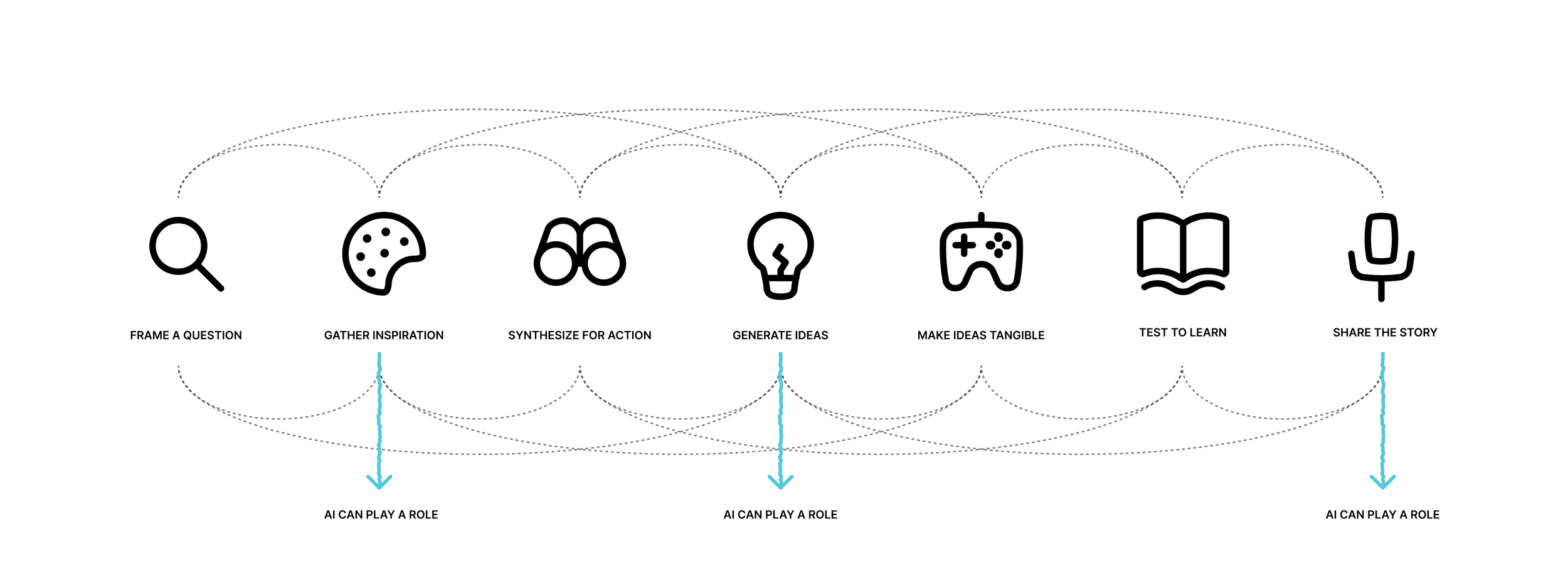
If people were to compare their visual design skills solely to AI, they might well come up short. AI has a distinct advantage when it comes to gathering and synthesizing information. As designers, design thinking is clearly the key ability that sets us apart from computers, which is precisely why design education remains so crucial.
The Danger of Skipping Foundations
While browsing online, I came across a concerning comment. It was made by a student who isn’t majoring in design but wants to switch careers to industrial design.
“I don’t have the time or energy to learn modeling and rendering, so I plan to sketch first, then use AI to generate product renderings, and submit them to design competitions to see if I can win something.”