Will AI Make You a Better Designer?
Observations on What It Means to Learn Design in the Age of AI
AI Is Reshaping Design Skill Development
Will AI make me a better designer? This is also a question I ask myself.
Searching for information, figuring out problems, the process has become much faster with AI’s help. The quick ask–answer method works well when questions suddenly appear. We can easily ask AI: I am stepping into industrial design, what software should I use? What skills do I need? The summarized answers are often more efficient than asking people around.
This changes something more fundamental: It changes how we learn.
One of my friend working in computer science once said:
“Our generation understands computers better because we had to figure things out ourselves.
Now people have easy access to information—but they stop digging deeper.”
The same shift is taking place in the field of design. With AI, everything is now at our fingertips. For example, if I need code, I can simply have AI write it for me. When it comes to problem-solving, AI is undoubtedly very powerful. But what about learning? I still have my doubts. Because learning design has never been just about getting the answers. Today, AI allows people to skip the following processes: developing judgment, navigating uncertainty, testing ideas, and thoroughly understanding why things work. AI not only makes learning easier, but it also makes it easier to stop learning prematurely.
What it Means To “Learn Design” In An AI Era
The good thing is: style ≠ design. And generation ≠ design either. AI can generate, humans can make decisions.
If design is reduced to output, then AI becomes very convincing. But this is not the case. Looking back at the design thinking process, AI can only play a significant role in certain areas.
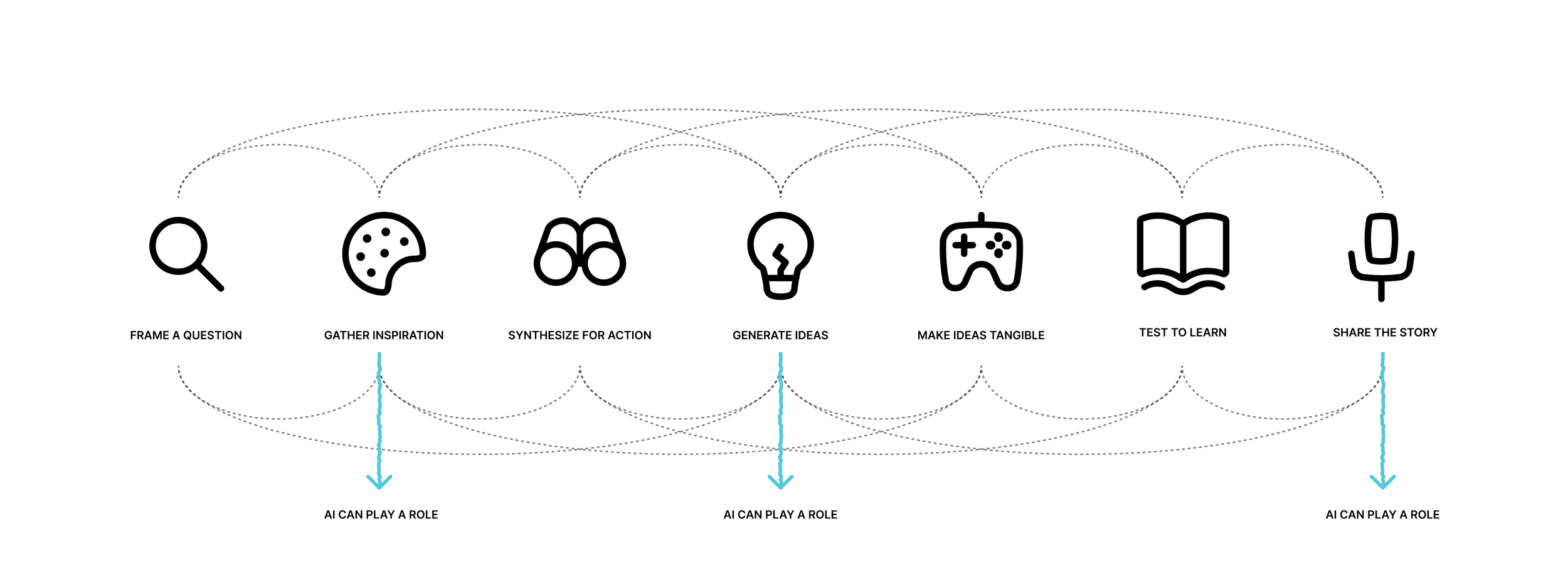
If people were to compare their visual design skills solely to AI, they might well come up short. AI has a distinct advantage when it comes to gathering and synthesizing information. As designers, design thinking is clearly the key ability that sets us apart from computers, which is precisely why design education remains so crucial.
Design Skills You Cannot Outsource To AI
“I don’t have the time or energy to learn modeling and rendering, so I plan to sketch first, then use AI to generate product renderings, and submit them to design competitions to see if I can win something.”
While browsing online, I came across a concerning comment. It was made by a student who isn’t majoring in design but wants to switch careers to industrial design.
This suggests a desire to move directly toward the outcome, while bypassing part of the process. It also reveals a deeper question: what is industrial design understood to be? If design is reduced to producing a visual result, then this approach seems reasonable.
But industrial design is ultimately about physical and tangible products, shaped by research, strategies, and decisions that go beyond appearance. In this student’s case, AI begins to replace parts of the understanding behind it, instead of supporting the process.
AI is undoubtedly lowering the barrier across many fields, including coding, video editing, and design. When tools become more powerful, it is natural that people begin to optimize for outcomes rather than capabilities. But this also introduces a subtle risk. It can create the impression that producing a result is equivalent to understanding it. That it is possible to arrive at an answer without fully engaging with the process that leads to it.
The Danger: Skill Stagnation Disguised as Productivity
Anyone can generate something that looks like design.But very few can explain why it should exist.
This distinction may be subtle, but it is crucial.
Generating is about creating possibilities. It is fast, flexible, and increasingly accessible.
Thinking, on the other hand, is about making decisions. It requires understanding context, defining constraints, and taking responsibility for the result.
In design, value has never been in producing the greatest number of options, but in choosing the right one and knowing exactly why. Today, as generation becomes easier, the question is no longer how many options can be produced, but how those options are defined.
In reality, design rarely begins in a state of complete freedom. Design is shaped by various constraints.
- how a product is used
- how a product is manufactured
- how much it costs
- the brand strategy
These constraints are not limitations to be avoided. They are the very guidelines that direct the design process.
On the other hand, if the user does not provide appropriate prompts, AI does not automatically establish constraints. When given clear conditions, it can produce highly relevant results. When they are not, the output often becomes vague, generic, and unpredictable.
This is where the role of the designer becomes more visible. Design is not about generating as much options as possible, but in defining the conditions under which those options make sense.
AI is a powerful tool. But what matters even more is the person using it.
What Type Of Design You Want To Become?
The question, ultimately, becomes this: Who remains valuable? And how do we ensure that we do?
As mentioned earlier, AI depends on a foundation to generate meaningful output.
In a similar way, designers rely on a foundation to make sound judgments. My partner David (who is also an industrial designer) and I had an interesting discussion about an idea:
“The highest form of design is not the craft itself, but the ability to create a good impact through good direction.”
This perspective leads to the conclusion that designers who focus solely on craftsmanship will gradually become irrelevant.
However, we wanted questioned this conclusion.
“It sounded like a perspective formed after experience—being able to judge what works and what doesn’t. But that ability is built through making, through hands-on practice, not just through observing generated results.”
AI cannot create a product and make decisions on your behalf—such as whether the manufacturing process is feasible, whether the user experience is sufficiently seamless, or whether the production costs align with the product’s positioning. However, an inexperienced designer is equally unable to make these judgments. In that sense, practical experience remains difficult to replace.
In the context of AI-generated content, I have started to notice a different kind of challenge. Design students sometimes struggle to distinguish whether a product is merely a concept or a tangible entity, specifically, whether something generated by AI can actually be manufactured. If it cannot be manufactured, can it still be considered a “real product”? I would put a question mark on that.
My original intention in writing this article was to explore the position of designers and their intrinsic value in an era dominated by AI. It wasn’t until I reached this point that I realized there is another challenge at play. Many students today are exposed to AI early in their learning process—sometimes before they have developed the experience needed to evaluate what they see. Without that foundation, it becomes harder to distinguish between what looks convincing and what is actually viable.
I can’t help to rethink why that intern asked the question. Perhaps, as design education grapples with the impact of AI, students are exposed to it before they’ve developed the critical judgment to assess it. The question of whether AI will replace designers completely feels less like something to answer, and more like something to understand.
If we reduce design to something that can simply be “generated,” then its replacement seems inevitable. But if we understand design as a process—of identifying problems, setting direction, working within constraints, and making decisions through practice—then its value does not disappear.
It shifts.
And in that sense, the question may no longer be whether designers will be replaced, but how we continue to think, decide, and take responsibility in a process that is increasingly easy to generate.
“ What we believe design to be?”