Product Iteration vs Product Innovation
Observations on Iteration and Innovation across different product categories.
The Problem With How We Talk About Innovation
I started thinking about this topic because I noticed a pattern among designers around me.
Some of us as designers struggle deeply with the idea of innovation. They question their own work, especially when they are building on something that already exists. One of the closest examples for me was my partner, a wonderful designer, who was working on a school project, reimagining a highly mature medical product. At one point, he was struggling with:
“I feel like all I did was combine functions and rearrange things, nothing truly innovative.”
To me, he had fallen into a familiar trap: the belief that if something is not completely new, it cannot be considered innovation. But in mature industries—medical design being a clear example that innovation is rarely about novelty. It is about making meaningful improvements within constraints.
I have worked in a similar case, which was re-designing a chromatography system for pharmaceutical production. The machine we were working with had been used in the industry for more than 15 years. Did it need iteration? Absolutely. Over time, user needs evolve, and so does the broader context around the product. But did it still work? Yes, and it had worked reliably for years.
This is what a mature product looks like. It has been tested, refined, and stabilized over time. In this context, innovation that only operates on the surface, something that simply looks new, doesn’t hold much value. The end result focused on a specific problem: reducing the footprint of the machine and improving the overall system. We didn’t invent a completely new system, we rethought an existing one. Does that mean the work wasn’t innovative?
I wouldn’t say so.
But how do we actually define innovation? That, to me, is the more interesting question.
What “Innovation” Even Means Once An Industry Matures
It is undeniable that most products in the world have already been designed or even been well designed. Some products ave already gone through countless iterations. Their core functions are stable. Their forms are not arbitrary, they are shaped by years of engineering, user feedback, regulation, and real-world use. What remains is not an empty canvas, but a dense system of constraints.
I was reminded of this during a discussion with a colleague while designing eyewear. We were reviewing different frame shapes when he pointed at one sketch and said:
“I have never seen this before. It looks new.”
That comment stayed with me.
Because eyewear is a highly mature industry. Almost everything is standardized: frame width, temple length, nose bridge proportions. These are not random decisions, they exist because they work. So the question for me became: is being completely new actually a good thing?everything. and my question was, is completely new the good thing?
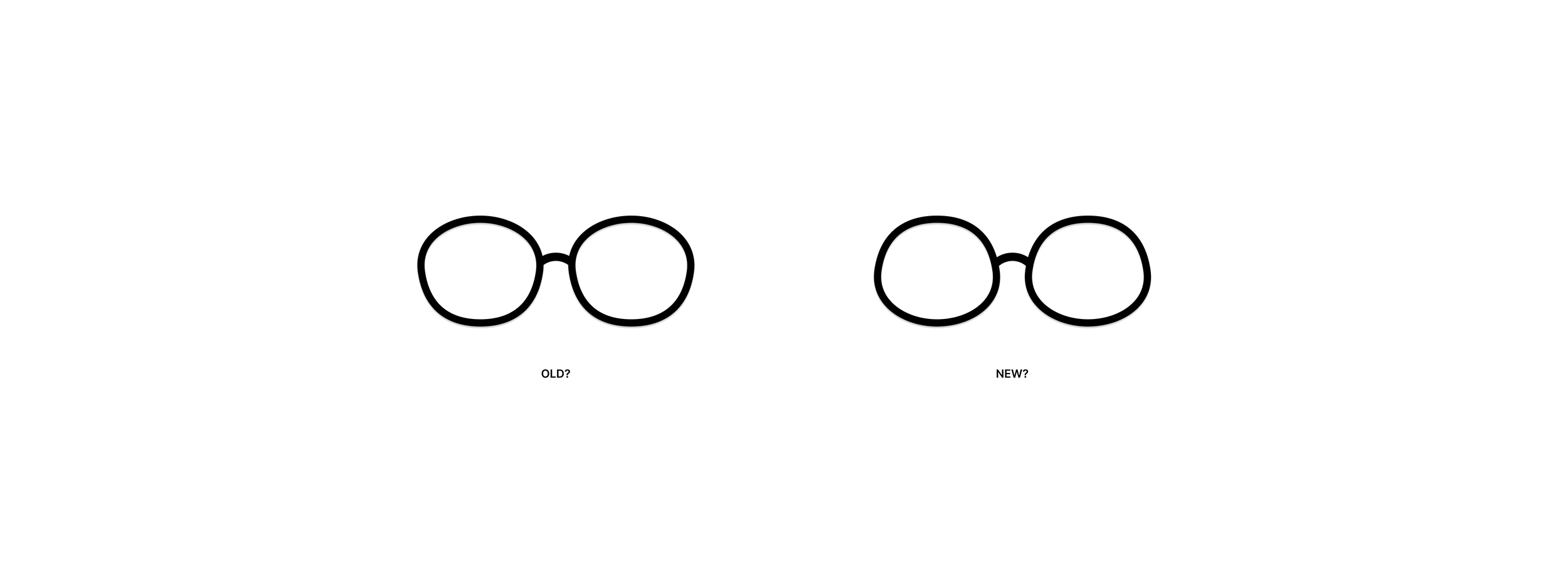
I have drawn simple graphic for better understanding. It’s exaggerated, but it makes the point clear. On one side is a standard frame shape. On the other is a more “interesting” one at first glance. But why eyewear rarely have shape on the right side? Because we need space for the nose.
A new form that compromises ergonomics, a new feature that adds unnecessary complexity, or a new interaction that disrupts established workflows. These are not innovations. They are interruptions. A scalpel handle, for example, should not be shaped like a bagel.
“Newness without context is not innovation. It is noise.”
In mature industries, innovation is rarely loud. It doesn’t present itself as something radically different. More often, it is quietly embedded in decisions that make a product work better without drawing attention to themselves.
And perhaps that is exactly why it is so often overlooked.
Small Improvements = Real Impact
Not all products allow the same type of innovation.
In some industries, especially those that are highly regulated and function-critical, the space for change is narrow, but the impact of that change can be significant. Medical products are a clear example.
These systems are often risk-sensitive and have already been optimized through years of engineering, testing, and real-world use feedback. Every detail exists for a reason. Every interaction carries weight.
Most real-world design impact comes from iteration. A slightly clearer interface can reduce user error. A better arrangement of components can improve workflow. Combining functions can lower cognitive load and make the system easier to understand under pressure.
These are not dramatic changes, but make differences.
This is why I disagreed with my partner when he said his work wasn’t innovative. What he described as “just combining functions and reorganizing things” is, in many cases, exactly where innovation happens.
If he had introduced a completely new function, I would have been surprise. Because true novelty in this space is rare, and often risky.
“Is this meaningfully better within this system?”
That’s the question to ask.
When Novelty Becomes a Trap
During my first job after graduating from my bachelor’s, I often heard a question that stayed with me: “Why can’t you come up with something more disruptive?” As a newcomer to the design industry, this was a source of anxiety.
Because behind that question was an assumption that innovation must be disruptive, and that disruption must look completely new. Innovation, in this sense, is reduced to a simple idea: doing something that hasn’t been seen before. The belief is that newness, by itself, is enough to justify a design decision.
But as I experienced while designing eyewear, this way of thinking quickly becomes problematic. “I’ve never seen this before” is not a strong argument. Because in mature industries, there is usually a reason why certain things have not been seen before.
In this context, novelty can become a trap.
It creates the illusion of innovation while bypassing the deeper understanding required to design something meaningful. It rewards what is immediately visible, rather than what is actually effective. It creates the illusion of innovation while bypassing the deeper understanding required to design something meaningful. It rewards what is immediately visible, rather than what is actually effective.
“It shifts the focus away from the user and toward designers’ desire to be seen.”
We look to platforms like Instagram, Behance, and Pinterest for inspiration. Over time, this can reinforce a simple equation: eye-catching equals good. Design agencies strive to create the next big hit product. Design awards often push this even further. When a product is reduced to a single poster or image, it becomes easy to predict what will stand out.
Designers see this. They learn from it. And gradually, this becomes their understanding of what design should be. Meanwhile, the system behind the product, the logic behind decisions, and the problems that truly matter are often overlooked.
So after realizing this, where does this leave us? Perhaps the answer is simpler and more demanding—than we expect.
Instead of asking, “Is this new enough?”, we might ask:
“Does this make things work better?”
“Does this reduce complexity or confusion?”
“Does this respond honestly to the constrains of the system and not making things up?”